
It’s 1963 in Belfast, and a young Hazel, just 18 years old steps onto a plane, about to embark on a mammoth journey as one of the first immigrants to leave Ireland via air bound for New Zealand.
What Hazel was leaving behind her as she began her journey; may well have been part of what pushed her to go. Beneath the surface in Northern Ireland, deep tensions were lurking. Decades-long divisions between Catholic and Protestant communities, compounded by political and economic inequalities, created a fragile and increasingly volatile situation, a situation that would later erupt into what became known as The Troubles. There was possibly a feeling among many families in Northern Ireland and for young people like Hazel, that their futures might be limited.
For some, maybe a better life seemed to lie far, far away from all that mounting unease?
With encouragement from her grandmother, who believed Hazel needed a bigger life. Hazel stepped onto that plane into the unknown. Would she find more opportunity in this far-flung, almost unheard-of country on the other side of the world?
Back in those days, emigrating wasn’t simple. Hazel recalls having to apply formally, filling out what felt like a mountain of forms and paperwork, and going through what she describes as a “stiff medical.” She never really thought it would amount to anything. But she also felt restless and always had a desire to travel so she told herself, Sure, I’ll try it for two years.
Little did Hazel know her life was about to completely change course.
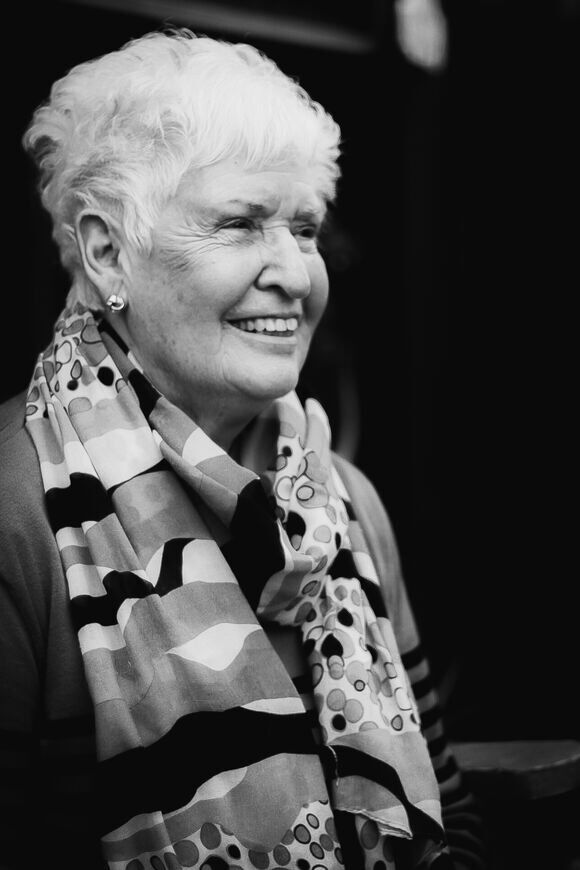 Hazel James - Patron of the Christchurch Irish Society.
Interviewed and Written by Kylee Dillane
Having left the green fields of the Emerald Isle behind Hazel arrived in London, the first major stop on her way to New Zealand. But the world was heavy with grief, just days earlier, on 22 November 1963, John F. Kennedy had been assassinated, sending shockwaves around the world. While in London, Hazel attended a memorial service at a St Paul’s Cathedral, standing among strangers, sharing in a collective sorrow. It was a sobering and unforgettable moment, a pause on her journey before stepping into the unknown.
She still keeps the original memorial booklet, a small but powerful keepsake from that day, a reminder of how her personal adventure began against the backdrop of a world-changing event.
Her journey continued across a long chain of international flights, back in the glory days of air travel, when there was still a hint of luxury in flying. One of her next stops was Karachi, where Hazel remembers another young woman on the same journey making a sudden decision. Hazel remembers with a laugh, her Irish brogue still thick:
“She got off in Karachi and decided she was going home!” That was it, she was done.
It was a true testament to Hazel’s sense of adventure and perhaps a little blind faith that she kept going, despite how daunting the experience must have felt. Maybe it was also a little bit of that Irish stubbornness that fuelled the desire to keep going..
From the stifling heat of Pakistan, Hazel boarded her next leg to Mumbai (then known as Bombay). And it was there, of all places, in a bathroom during the stopover, after hearing Hazel chatting to someone that another young voice turned to her and said, in a familiar lilt said: “Is that an Irish accent?”
On the biggest journey of their lives, a lifelong friendship was born, one Hazel still treasures to this day.
After more stops in Singapore, Darwin, and Brisbane, Hazel finally landed in Auckland, she had reached New Zealand at last. It’s hard to imagine what it must have felt like for an 18-year-old to step into a brand-new country, in a strange city, not knowing a single person. Excitement, fear, exhaustion, and hope were all tangled together as Hazel stood on the other side of the world, about to begin an entirely new life. Hazel’s journey continued by train from Auckland to Wellington, then across the water to the South Island, finally arriving in Ashburton.
Back then, if you knew someone in a town, immigration would send you there to ensure you had at least a small support network and let’s not forget, Hazel was still just a teenager! Her first impressions of Ashburton were immediate and blunt: She thought: “I’ve made the biggest mistake of my life. It felt too small, too quiet.”
Had she really travelled across numerous continents, crossed oceans, and left everything familiar behind, all for her new life of adventure, only to end up here? Ashburton seemed to offer little of the excitement or people her own age she had hoped for… until a connection in Christchurch changed everything.
Through a connection with a family in Christchurch, Hazel was invited to a dance, a simple gesture that would alter the course of her life. The young man who was meant to take her pulled out at the last minute, and his older brother stepped in.
“I ended up going with his brother… seven years older than me. And he ended up as my husband.”
That chance encounter brought Hazel to Christchurch, led to her marriage to a kiwi, Malcolm James, and marked the true beginning of her life in New Zealand.
Over the years, life got busy for Hazel and Malcolm with the arrival of their two children and Hazel taking up jobs in social work. Hazel describes feeling a little lost at times, but marrying into Malcolm’s large, supportive family brought her happiness, even if sometimes it felt as though she was far from home. A real shift happened when Irish dancing entered her world through her daughter Jo. Back then, if you wanted to do Irish dancing, you had to join the Irish Society, and that’s where Hazel found her people.
“Within the Society, I felt very comfortable. It was a little slice of home.”
Hazel recalls the strong community spirit of those days, everyone helping with fundraisers, events, and supporting one another. She acknowledges that the world has changed, and recognises that the Irish Society must adapt to meet the different demands of life today. Yet Hazel still holds hope for the Society’s future and a deep love for it. Through life’s highs and lows, she has always kept her membership.
“I always kept my membership. Something always made me hold onto it.”
Hazel would love to see the Irish Society thrive and the younger generation re-engage: “I’d love to see it continue, but in a way that works for today.”
She speaks fondly of the Rose of Tralee, describing the event as an emotional anchor that has often seen her through hard times: “It’s the one thing that really filled a gap in my life. I always felt good when I went. It felt like home.”
When asked how she has maintained her Irish identity after 63 years in New Zealand, Hazel didn’t hesitate: “I’m Irish Irish.” Even after decades spent across the world in New Zealand, Hazel’s bond with Ireland has never weakened. The sense of belonging, of home, remains a powerful force in her life, carried with her across the miles.
If there’s any true test of allegiance, it’s on the rugby field, and when it comes to rugby, Hazel sums it up perfectly:
“I love the All Blacks, but when they play Ireland, it’s Ireland all the way. You can’t help it. It’s in your blood.”
I don’t think there’s any danger of Hazel donning a black shirt anytime soon.